
SUMMARY
Goddess Sarasvati: The White Lotus Mother is an exhaustive exploration of the feminine embodiment of the primordial sound. This work serves as a bridge between the ancient world—where Sarasvati was a mighty, life-sustaining river—and the internal world, where she resides as the spark of intuition and the architect of language.
Throughout these pages, the reader will journey through the Puranic genealogies, exploring her complex relationship with the Trinity and her independent status as the sovereign of the arts. We dissect every element of her iconography, from the mathematical significance of the Akshamala (rosary) to the vibrational frequency of the Veena. This book is not merely a collection of stories; it is a guide to reclaiming the "Sarasvati Element" within oneself—cultivating a life of discernment, creative flow, and intellectual purity. By the final chapter, the reader will understand why, in an age dominated by information, the world more than ever requires the wisdom of the White Lotus Mother.
COPYRIGHT
Copyright © 2026 by MiMi Flix
All Rights Reserved. No part of this publication may be reproduced, stored in a retrieval system, or transmitted in any form or by any means—electronic, mechanical, digital, photocopy, recording, or any other—except for brief quotations in printed reviews, without the prior written permission of the author, MiMi Flix.
Limited Edition Release: April 21, 2026 First Printing: 2026
The information provided in this book is for educational and spiritual exploration purposes. While every effort has been made to ensure the accuracy of the mythological interpretations and historical data, the author assumes no responsibility for errors or omissions.
DEDICATION
To the Eternal Mother, the silent witness to every word ever spoken and every note ever played. You are the ink in the pen and the breath in the flute.
To the scholars who kept the lamps of the Vedas burning through the dark ages, and to the parents who first place a book in a child's hand, initiating them into the sacred mysteries of the alphabet.
And finally, to the seekers who understand that true wealth is not held in the hand, but in the clarity of the mind.
EPIGRAPH
The Invocation of the Muse
Sarasvatī namastubhyam varade kāmarūpiṇī | Vidyārambham kariṣyāmi siddhirbhavatu me sadā ||
Translation: "O Goddess Sarasvati, my humble salutations to you. You are the giver of boons and the fulfiller of wishes. As I begin my journey into the world of knowledge, I pray that you grant me success and perfection in all my endeavors forever."
— The Sarasvati Prarthana
FOREWORD
The pursuit of knowledge in the 21st century has become a frantic race for data, yet we find ourselves increasingly starved for wisdom. It is in this paradox that the figure of Goddess Sarasvati becomes most relevant. As a recognized symbol of the "Pure Intellect," her mythology offers a roadmap for navigating a world of noise.
This work by MiMi Flix arrives at a crucial juncture. It invites the reader to step away from the transactional nature of modern learning and return to the "Satyaloka"—the realm of truth. In these chapters, the author meticulously reconstructs the identity of the Goddess, ensuring that she is seen not just as a silent idol, but as a vibrant, rhythmic force that governs the laws of nature and the structures of our thoughts. To read this book is to sit at the feet of the Mother of the Vedas and listen to the symphony of the universe.
PREFACE
The inception of this book was not found in a library, but in a moment of profound silence. As the creative force behind MiMi Flix, I have always been fascinated by how ideas are born. Where does a melody come from? How does a blank page transform into a story? These questions led me inevitably to the feet of the White Lotus Mother.
In writing this, I sought to move beyond the "surface-level" descriptions found in standard encyclopedias. I wanted to understand why she wears white instead of gold, why she rides a swan that can separate milk from water, and why her river vanished from the earth only to flow through our consciousness. This book is the result of years of contemplation on the nature of Vidya (knowledge). It is written for the artist who has lost their muse, the student who seeks more than a degree, and the devotee who wishes to understand the profound philosophy behind the form. My hope is that as you turn these pages, you feel the "Inner Sarasvati" beginning to flow within you once more.
ACKNOWLEDGMENTS
This book is a collective effort of the past and the present. I must first acknowledge the ancient rishis and poets, whose visionary hymns in the Rig Veda provided the foundation for everything we know of the Goddess. Their devotion to the "Holy Word" is the heartbeat of this text.
I am deeply grateful to the editors and researchers at MiMi Flix who spent countless hours verifying Puranic lineages and cross-referencing artistic traditions across Asia. To the librarians and caretakers of sacred texts, your preservation of our heritage made this synthesis possible. Finally, I thank you, the reader. By picking up this book, you are participating in the ancient tradition of Svadhyaya (self-study), and for that, you have my deepest respect.
NOTE ON TRANSLITERATION
The Sanskrit language is a system of "perfected sound," where the vibration of the word is as important as its meaning. To honor this, we have used a modified transliteration system throughout this book.
While we have retained familiar spellings like Sarasvati or Shiva for ease of reading, technical terms and mantras are presented with phonetic guides to help the reader "feel" the resonance of the language. Where a word has deep philosophical weight—such as Viveka (discernment) or Vach (speech)—we have provided an expanded definition in the text to ensure the essence of the Goddess’s language is never lost in translation.
GODDESS SARASVATI
THE WHITE LOTUS MOTHER: HER LEGENDS, SYMBOLISM, AND DIVINE GRACE
Part I: Origins and Evolution
The Vedic River: The Liquid Form of Divinity
In the earliest dawn of human consciousness, as recorded in the Rig Veda, Sarasvati was not a seated goddess with a lute, but a thunderous, life-giving torrent. She was the "Greatest of Mothers, Greatest of Rivers, and Greatest of Goddesses" (Ambitame Naditame Devitame Sarasvati).
The Geological Majesty Thousands of years ago, the Sarasvati River was a physical reality—a massive waterway flowing from the Himalayas to the Arabian Sea, cutting through what is now the Thar Desert. It was the lifeline of the Vedic civilization, its banks serving as the cradle for the first hymns of humanity. Geologically, the drying of this river around 1900 BCE due to tectonic shifts and climate change is one of history’s great mysteries. In this book, we explore how the physical disappearance of the water forced the river to migrate from the earth into the spirit, becoming a "mythical" river that flows invisibly at the confluence of the Ganga and Yamuna in Prayagraj.
The Spiritual Significance As a river, Sarasvati represented Flow. Just as water washes away physical impurities, the Vedic river was believed to wash away the dross of the mind. She was the original source of fertility, not just for the soil, but for the intellect. The sound of her rushing waters was the first music, and the rhythm of her tides was the first meter of poetry.
Transition to Transcendence: From Water to Wisdom
As the physical river receded, the concept of Sarasvati underwent a profound metaphysical transformation. She transcended her liquid form to become Vach Devi—the Goddess of Speech.
📚 LOGIN TO READ & LISTEN FULL E-BOOK & AUDIO-BOOK
NEW HERE? CREATE AN ACCOUNT IN SECONDS.
YOU MAY ALSO LIKE

KRISHNA JANMASHTAMI
KRISHNA JANMASHTAMI PREFACE The story of Krishna Janmashtami is more than just a tale from the past; it is a celebration of hope that has lived in the hearts of millions for thousands of years. In the middle of a dark, stormy night, in a small prison cell in the city of Mathura, a light was born that would change the world forever. This book was created to tell that...

GANESH CHATURTHI: THE BIRTH OF GANESHA
Birth of Ganesha SUMMARY In the frozen, silent reaches of Mount Kailash, a divine mother’s longing for a loyal protector gives rise to a legend that will echo through eternity. THE BIRTH OF GANESHA: FROM SANDALWOOD TO DIVINITY tells the profound story of a boy created from devotion, whose unwavering "loyalty" to his mother, Goddess Parvati, leads him into a historic confrontation with the mighty Lord Shiva. This is not...
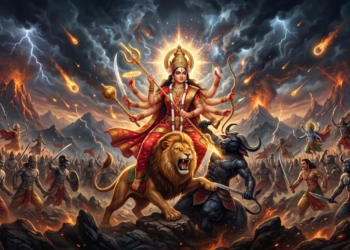
THE DIVINE VICTORY: THE STORY OF DURGA PUJA
Durga Puja SUMMARY This eBook tells the ancient and powerful story of Goddess Durga and her battle against the forces of evil. It is a story that has been passed down through thousands of years, representing the eternal fight between right and wrong. The narrative follows the rise of a terrifying demon king named Mahishasura, who gained a special power that made him think he was better than the gods....

THE ETERNAL ADVENT: HANUMAN JAYANTI
Hanuman Jayanti Birth Story SUMMARY The Eternal Advent: Hanuman Jayanti is a meticulous and immersive exploration of one of the most sacred events in Vedic history. While many are familiar with the heroic deeds of Lord Hanuman in the Ramayana, few have traversed the deep, multi-layered journey of his arrival on Earth. This book chronicles the transition of the eleventh expansion of Shiva—the Rudra Avatar—from the celestial realms into the...


